It keeps your tear film from breaking up
stable tear film keeps moisture distributed across the eye between blinks. In a 30-day study, adults taking 12 mg daily showed improved tear break-up time and dry-eye symptom scores.†
You shouldn't be aware of your eyes. Lately, you are.
Gritty. Scratchy. Like something's stuck in there that isn't. That's not your eyes breaking down. It's eyes worn thin by screens, glare, dry air, and long visual days.
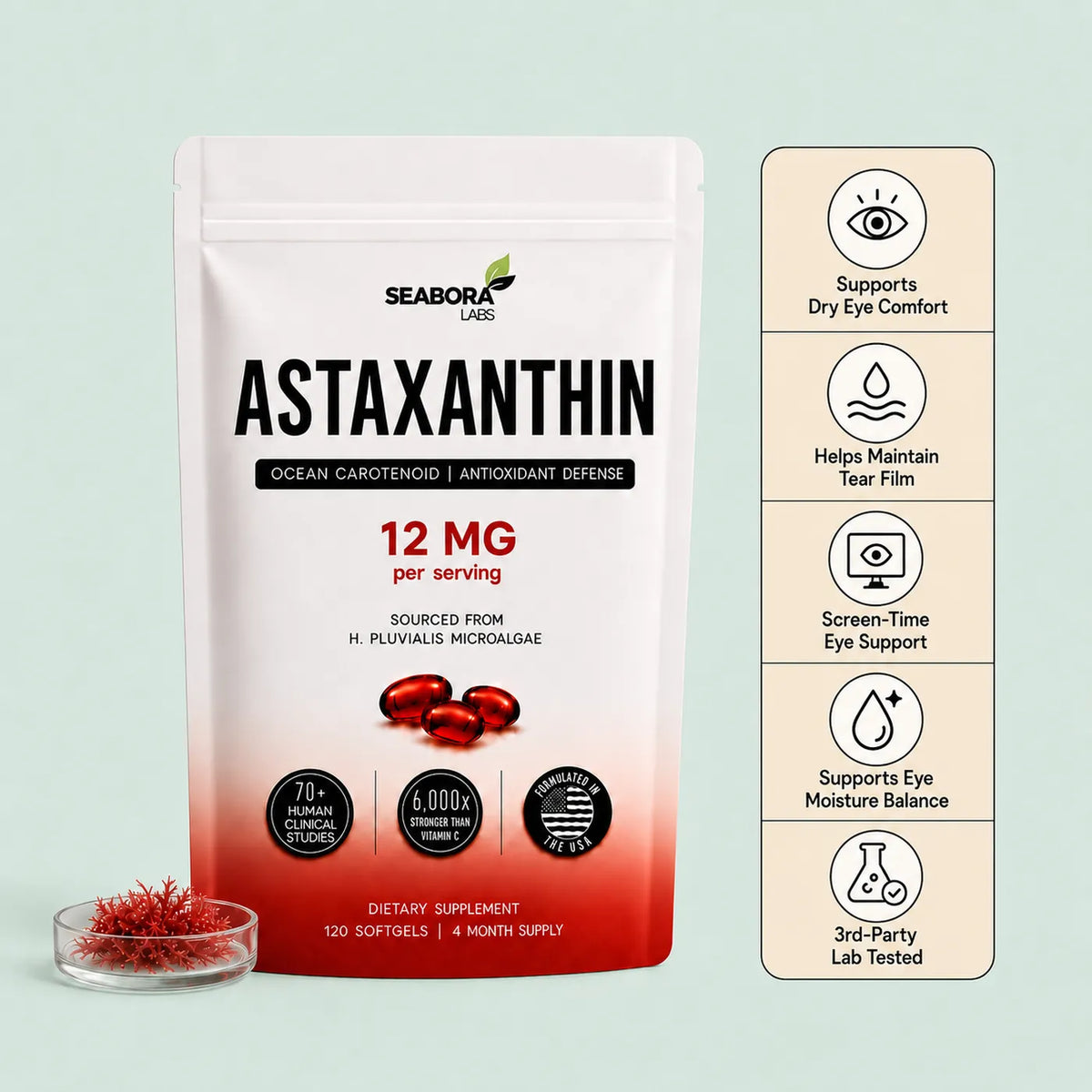
Astaxanthin 12mg is a once-daily softgel that supports the moisture layer those days wear down.
Long screen hours, reduced blinking, dry air, glare, and aging increase oxidative stress and weaken tear-film stability. Astaxanthin is one of nature's most powerful carotenoid antioxidants. While lubricating drops provide temporary surface moisture, Seabora delivers 12 mg of natural astaxanthin from Haematococcus pluvialis for daily antioxidant support from within.
It supports:
Daily nutritional support-not an instant lubricant or a replacement for prescribed eye care.
Astaxanthin works gradually, so do not expect the immediate sensation provided by eye drops. In one 30-day human study using 12 mg daily, improvements in symptom scores and tear-film measurements were observed after 14 days, with additional measures improving by day 30.
A realistic expectation is to take it consistently for 4-8 weeks before judging your results. Some people notice a difference sooner, while others require longer. Individual results vary, and daily consistency matters.
Seabora Astaxanthin is designed for adults who want daily support for dry-feeling, screen-tired eyes, including:
Anyone who is pregnant, nursing, taking medication, managing a medical condition, or already receiving treatment for an eye condition should speak with a healthcare professional before use. Persistent eye pain, light sensitivity, discharge, or sudden vision changes require professional eye care.
It doesn't make sense at first.
Your eyes water.
They tear up at your desk, in the wind, on the drive home.
So how can they possibly be dry?
But that's the trap.
You blot them. You blink. You reach for the drops.
Few hours later they're burning again.
Gritty. Tired.
Like there's sand under your lids that won't wash out.
Screens make it worse. So does the AC.
So does night driving.
You're not imagining it, and you're not alone. Here's what's actually going wrong underneath, blink by blink, hour by hour on a screen.
You blink 15 to 20 times a minute normally. Locked onto a screen, that can fall by half. Fewer blinks means the thin film of moisture on your eye evaporates faster than it's replaced, usually before you feel it.
Screen light, glare, dry air and age all raise oxidative stress on the eye's surface. Unstable molecules called free radicals pile up faster than your eyes can clear them. Think tiny sparks, more than the eye can mop up.
Those sparks land on the tiny oil glands in your eyelids. Every blink, they're meant to coat your tears with a thin oil layer that seals moisture in, until that layer turns thin and patchy.
Moisture leaks through the failing seal. Your eyes panic and flood with watery reflex tears that spill over and vanish just as fast.
Watery and dry.
At the same time.
Because the real problem was never on the surface.
They soothe for a few hours, evaporate, and the cycle restarts all day. The damage is happening underneath, at the oil glands and inside the eye's cells. That's the gap drops were never built to reach.
stable tear film keeps moisture distributed across the eye between blinks. In a 30-day study, adults taking 12 mg daily showed improved tear break-up time and dry-eye symptom scores.†
Remember those sparks? Screens, glare, dry air and age drive oxidative stress in the eyes. Astaxanthin is one of nature's strongest antioxidants, providing defense against exactly that daily strain.
Vitamin C is water-soluble, so it stays outside. Beta-carotene slides into the oily middle and stops there. Astaxanthin is long enough to go all the way through, like a bolt with a head resting on each face.
The oil component of the tear film helps slow moisture evaporation. The same study found improved meibum quality after 30 days of daily use.†
Astaxanthin is a fat-soluble carotenoid described in scientific research as able to cross the blood-retinal barrier. This allows it to provide antioxidant support within protected tissues of the eye—not only at the surface.*
Where the red comes from
It spends most of its life green and swimming. Then the sun turns brutal, the pond starts to vanish, and it saves itself by turning blood red.
The algae lives in a shallow pond, swimming with two small tails. In this state it is soft, thin-walled, and carries almost no astaxanthin.
Summer comes. The water drops and the sun beats down on what is left. There is no deeper water to swim to.
The algae sheds both tails and stops moving. It builds a thick wall around itself and shuts down, trapped in the open sun.
Sealed and exposed, it floods its own cells with astaxanthin — a shield against the light that would otherwise destroy it. Green becomes deep red.
That red cell, at its most loaded, is what we take. The astaxanthin in your softgel is the shield an algae built to stay alive.

Five popular eye nutrients, compared on the things you actually feel.
Omega-3
Lutein + Zeaxanthin
Vitamin C
CoQ10
Astaxanthin improved the signs and symptoms of mild-to-moderate dry eye in middle-aged and elderly patients.
Astaxanthin reduced the oxidative stress caused by prolonged visual display terminal (screen) work.
An oral antioxidant supplement with astaxanthin increased tear production and improved tear-film stability.
Liposomal astaxanthin protected the corneal surface against oxidative stress in a dry-eye model.
Astaxanthin alleviated dry-eye symptoms by mitigating oxidative stress and inflammation on the ocular surface.
Astaxanthin targeted the hyperosmolar, pro-inflammatory stress on the ocular surface seen in experimental dry eye.

Review 1 of 8
It works on the oil layer, not the surface.
Your tear film is sealed by a thin layer of oil produced by tiny glands in your eyelids. Screen light, glare, dry air and age drive oxidative stress on those glands. Free radicals build up faster than your eyes can clear them, the oil turns thin and patchy, and moisture escapes before your next blink replaces it. That's the dryness — and the watery reflex tears that follow it.
Astaxanthin is a fat-soluble carotenoid from Haematococcus pluvialis microalgae. Most antioxidants sit at one end of a cell membrane and protect one side. Astaxanthin's molecule is long enough to span the entire membrane and anchor at both surfaces — so it neutralises free radicals inside and outside the cell at the same time. Because it's fat-soluble, it reaches the oil-rich tissue where the damage is happening.
In a 30-day study of adults taking 12 mg daily, researchers measured 56% less dry-eye discomfort on the symptom score, 31% better tear-film stability, and improved meibum quality from those same glands.†
Between week four and week eight for most people.
Weeks 1–3: astaxanthin is building up in the tissue. You won't feel much yet — this is the stretch where people quit, and it's the stretch that decides whether the rest works.
Weeks 4–8: the turning point. Long screen days stop ending in that dry, gritty crash. Reading and computer work stay comfortable for longer. The drop bottle stops travelling from desk to car to nightstand.
Weeks 8–12: comfort steadies out. Air conditioning, glare and night driving stop hitting as hard.
One pouch is 120 softgels — a four-month supply — because that's how long an honest trial takes. This is gradual, not overnight.
They're solving a different part of the problem — or a different part of the eye.
Omega-3 supplies raw material for the oil in your tear film. Useful, but it doesn't stop the oxidative stress that's degrading the glands producing that oil. You're topping up a tank with a leak in it.
Lutein and zeaxanthin concentrate in the macula — the back of the eye. They're built for long-term retinal health, not for the tear film on the front surface.
Astaxanthin is the one measured directly on the things dry-eye sufferers actually feel: tear break-up time, meibum quality and symptom scores. And you're getting 12 mg of a single ingredient — not a trace amount buried in a fourteen-ingredient blend built to look impressive on a label.
No — and you shouldn't. They're doing different jobs.
Drops add moisture to the surface right now. They work fast and they wear off fast, because the oil seal that's supposed to hold that moisture in is the thing that's worn down. Astaxanthin works underneath, on that seal.
Most people keep drops nearby through the first few weeks and simply reach for them less often as the weeks go on. Use both. Nothing about this asks you to choose.
Yes. There is no shellfish and no fish in this product.
Astaxanthin is the pigment that makes salmon, shrimp and krill pink — but they don't make it. They eat it. Seabora sources it from the original plant source: Haematococcus pluvialis, a freshwater microalgae grown in controlled conditions, then third-party lab tested for purity.
ADD YOUR ALLERGEN FACILITY STATEMENT HERE if you have one — e.g. 'Produced in a facility that does not process shellfish.' If you can't verify it, delete this line rather than imply it.
One softgel a day, with a meal that contains some fat.
Astaxanthin is fat-soluble, so it absorbs alongside dietary fat. Breakfast with eggs or lunch will do more for you than an empty stomach first thing. Time of day doesn't matter — consistency does.
If you miss a day, take the next one as normal. Don't double up.
With supplements, yes. It's a single ingredient, so it sits alongside a multivitamin, omega-3 or a lutein formula without duplicating anything — and several of those pair naturally with it.
If you take blood thinners or blood-pressure medication, have a two-minute word with your pharmacist before you start. Not because of anything unusual in this product — it's simply the sensible check with any antioxidant supplement. Not intended for use during pregnancy or nursing.
Then you get your money back. You have 90 days.
Take it daily, give it the full window, and if your eyes don't feel different, email SUPPORT@SEABORALABS.COM and we refund you — STATE IT PLAINLY: full price, no return needed / minus shipping.
Fewer than 1% of customers use it. We'd still rather you find out on our money than talk yourself out of trying.