Supports a stronger tear film
Screens make you blink less, so tears dry up faster. Astaxanthin supports tear-film stability and longer-lasting eye comfort.

Oxidative stress from screens, dry air, and long visual days quietly wears your eyes down.
One daily softgel defends against that hidden stress and supports the moisture layer your eyes rely on.
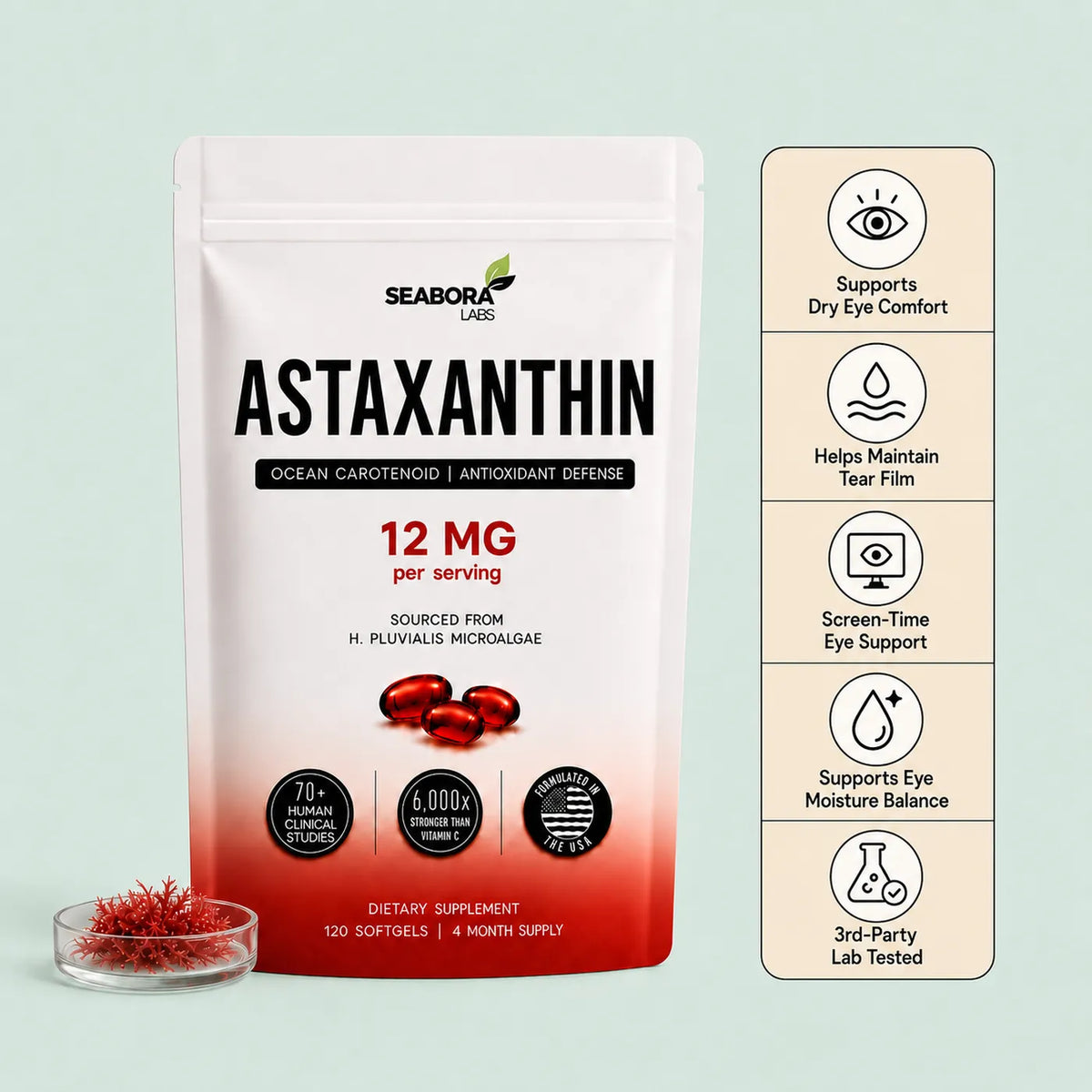
Long screen hours, reduced blinking, dry air, glare, and aging increase oxidative stress and weaken tear-film stability. Astaxanthin is one of nature's most powerful carotenoid antioxidants. While lubricating drops provide temporary surface moisture, Seabora delivers 12 mg of natural astaxanthin from Haematococcus pluvialis for daily antioxidant support from within.
It supports:
Daily nutritional support-not an instant lubricant or a replacement for prescribed eye care.
Astaxanthin works gradually, so do not expect the immediate sensation provided by eye drops. In one 30-day human study using 12 mg daily, improvements in symptom scores and tear-film measurements were observed after 14 days, with additional measures improving by day 30.
A realistic expectation is to take it consistently for 4-8 weeks before judging your results. Some people notice a difference sooner, while others require longer. Individual results vary, and daily consistency matters.
Seabora Astaxanthin is designed for adults who want daily support for dry-feeling, screen-tired eyes, including:
Anyone who is pregnant, nursing, taking medication, managing a medical condition, or already receiving treatment for an eye condition should speak with a healthcare professional before use. Persistent eye pain, light sensitivity, discharge, or sudden vision changes require professional eye care.
It doesn't make sense at first.
Your eyes water.
They tear up at your desk, in the wind, on the drive home.
So how can they possibly be dry?
But that's the trap.
You blot them. You blink. You reach for the drops.
Twenty minutes later they're burning again.
Gritty. Tired.
Like there's sand under your lids that won't wash out.
By midafternoon your eyes feel wrung out.
Screens make it worse. So does the AC.
So does night driving, when every headlight blooms into a glare you have to squint through.
"Just use drops," everyone says.
You already have.
The redness ones. The dry eye ones. The thick gel for nighttime.
Each one buys you twenty minutes. Then you're right back to burning.
The eye doctor says everything looks normal.
But "normal" isn't how they feel.
You're not imagining it, and you're not alone. Here's what's actually going wrong underneath, blink by blink, hour by hour on a screen.
You blink 15 to 20 times a minute normally. Locked onto a screen, that can fall by half. Fewer blinks means the thin film of moisture on your eye evaporates faster than it's replaced, usually before you feel it.
Screen light, glare, dry air and age all raise oxidative stress on the eye's surface. Unstable molecules called free radicals pile up faster than your eyes can clear them. Think tiny sparks, more than the eye can mop up.
Those sparks land on the tiny oil glands in your eyelids. Every blink, they're meant to coat your tears with a thin oil layer that seals moisture in, until that layer turns thin and patchy.
Moisture leaks through the failing seal. Your eyes panic and flood with watery reflex tears that spill over and vanish just as fast. So they run and burn, at the same time.
Watery and dry. At the same time.
Because the real problem was never on the surface.
They soothe for a few minutes, evaporate, and the cycle restarts all day. The damage is happening underneath, at the oil glands and inside the eye's cells. That's the gap drops were never built to reach.
Eye drops
Astaxanthin
The mechanism behind how one 12 mg softgel supports tear comfort, tear-film stability, and your eye's defenses against daily strain.
Screens make you blink less, so tears dry up faster. Astaxanthin supports tear-film stability and longer-lasting eye comfort.
Remember those sparks? Screens, glare, dry air and age drive oxidative stress in the eyes. Astaxanthin is one of nature's strongest antioxidants, providing defense against exactly that daily strain.
Astaxanthin supports healthy circulation in the eyes, helping deliver oxygen and nutrients to hard-working eye tissues.
Screen use keeps the focusing muscle working to hold nearby text sharp. Astaxanthin supports this system and helps the eyes shift between near and far.
Astaxanthin is studied for crossing the blood-retinal barrier, supporting the retina, tear film, circulation and focusing comfort from the inside, where drops can't reach.
Less dry, less gritty, less tired at the end of a long screen day.
Not another bottle you reach for every hour.
One small softgel, once a day.
Compare 5 popular eye nutrients on the things dry-eye sufferers actually feel.
Omega-3
Lutein + Zeaxanthin
Vitamin C
CoQ10
Astaxanthin improved the signs and symptoms of mild-to-moderate dry eye in middle-aged and elderly patients.
Astaxanthin reduced the oxidative stress caused by prolonged visual display terminal (screen) work.
An oral antioxidant supplement with astaxanthin increased tear production and improved tear-film stability.
Liposomal astaxanthin protected the corneal surface against oxidative stress in a dry-eye model.
Astaxanthin alleviated dry-eye symptoms by mitigating oxidative stress and inflammation on the ocular surface.
Astaxanthin targeted the hyperosmolar, pro-inflammatory stress on the ocular surface seen in experimental dry eye.

Review 1 of 8